|
| void | cancel () |
| | Notify manipulator of touch canceling. More...
|
| |
| Node * | getAttachedNode () const |
| | Gets the node to which the input manipulator is attached. More...
|
| |
| InputManipulator * | getDependantManipulator () const |
| | Gets the dependant input manipulator. More...
|
| |
| EventRoutingMode | getEventRoutingMode () |
| | Returns the current input event routing mode. More...
|
| |
| InputManipulatorWeakPtr | getFailManipulator () const |
| | Gets the fail manipulator. More...
|
| |
| State | getState () const |
| | Get the state of an input manipulator. More...
|
| |
| KZ_DEPRECATED TouchEventRoutingMode | getTouchEventRoutingMode () |
| | Returns the current touch event routing mode. More...
|
| |
| ManipulatorType | getType () const |
| | Returns the type of the input manipulator. More...
|
| |
| bool | isActive () const |
| | Checks whether an input manipulator is in active state. More...
|
| |
| bool | isAttached () const |
| | Tells whether the input manipulator is attached to a node. More...
|
| |
| bool | isCancelable () const |
| | Checks whether an input manipulator is in a cancelable state. More...
|
| |
| bool | isResettable () const |
| | Checks whether an input manipulator is in a resettable state. More...
|
| |
| void | requireToFail (InputManipulatorWeakPtr manipulatorToFail) |
| | Sets the input manipulator that must fail before Kanzi can recognize this input manipulator. More...
|
| |
| void | reset () |
| | Reset the manipulator. More...
|
| |
| void | setEventRoutingMode (EventRoutingMode mode) |
| | Sets the input event routing mode that you want the input manager to use when distributing the input event data to manipulators. More...
|
| |
| void | setReferenceNode (NodeWeakPtr referenceNode) |
| | Override the attached node as the hit test reference node. More...
|
| |
| void | setState (State state) |
| | Set the state of an input manipulator. More...
|
| |
| KZ_DEPRECATED void | setTouchEventRoutingMode (TouchEventRoutingMode mode) |
| | Sets the touch event routing mode that you want the input manager to use when distributing the touch points to input manipulators. More...
|
| |
| | ~InputManipulator () override |
| | Destructor. More...
|
| |
| AppliedStyleEntrySharedPtr | applyObjectStyle (kanzi::StyleSharedPtr style) |
| | Applies a style to an object. More...
|
| |
| void | applyObjectStyles () |
| | Apply all styles for an object node. More...
|
| |
| Domain * | getDomain () const |
| | Returns the domain the object belongs to. More...
|
| |
| const Metaclass * | getDynamicMetaclass () const override |
| | Returns the metaclass of the dynamic type of the object. More...
|
| |
| MainLoopScheduler * | getMainLoopScheduler () const |
| | Returns the MainLoopScheduler instance of the associated Domain. More...
|
| |
| detail::MessageDispatcher * | getMessageDispatcher () const |
| | Returns the message dispatcher of the object. More...
|
| |
| ResourceManager * | getResourceManager () const |
| | Returns the resource manager of the object. More...
|
| |
| ScriptingContextSharedPtr | getScriptingContext () const |
| | Gets the scripting context of the object. More...
|
| |
| | Object (Domain *domain) |
| |
| void | setScriptingContext (ScriptingContextSharedPtr context) |
| | Sets the scripting context of the object. More...
|
| |
| void | unapplyObjectStyle (AppliedStyleEntrySharedPtr appliedStyleEntry) |
| |
| void | unapplyObjectStyles () |
| | Unapplies and removes all applied styles. More...
|
| |
| | ~Object () override |
| |
| bool | isTypeOf (const Metaclass *objectType) const |
| | Determines if the type of this object is the given type or derived from it. More...
|
| |
| virtual | ~MetaObject () |
| |
| template<typename DataType > |
| void | addPropertyModifier (const PropertyType< DataType > &propertyType, typename PropertyType< DataType >::Descriptor::ModifierCallback callback, void *owner) |
| |
| template<typename DataType > |
| void | addPropertyNotificationHandler (const PropertyType< DataType > &propertyType, typename PropertyType< DataType >::Descriptor::NotificationCallback callback, void *owner) |
| |
| template<typename DataType > |
| void | addPropertyValueSource (const PropertyType< DataType > &propertyType, typename PropertyType< DataType >::Descriptor::TypedValueSource *valueSource, PropertyValuePrecedence precedence, void *ownerPointer) |
| |
| template<typename DataType > |
| void | addPropertyValueSource (const PropertyType< DataType > &propertyType, typename PropertyType< DataType >::Descriptor::TypedValueSource *valueSource, PropertyValuePrecedence precedence, AbstractPropertyTypeDescriptor::ValueSourceOwner *owner) |
| |
| PropertyStorageContainer::iterator | beginPropertyStorage () |
| | Returns the begin iterator to the internal property storage container. More...
|
| |
| PropertyStorageContainer::const_iterator | beginPropertyStorage () const |
| | Returns the begin iterator to the internal property storage container. More...
|
| |
| void | clearPropertyFlag (AbstractPropertyType propertyType, uint32_t flag) |
| |
| void | copyLocalValue (const PropertyObject &other, AbstractPropertyType propertyType) |
| | Copies local value of single property from another object. More...
|
| |
| void | copyLocalValues (const PropertyObject &other) |
| | Copies all local values from another object. More...
|
| |
| PropertyStorageContainer::iterator | endPropertyStorage () |
| | Returns the end iterator to the internal property storage container. More...
|
| |
| PropertyStorageContainer::const_iterator | endPropertyStorage () const |
| | Returns the end iterator to the internal property storage container. More...
|
| |
| template<typename DataType > |
| PropertyType< DataType >::Traits::ReturnType | getAbstractProperty (AbstractPropertyType abstractPropertyType) const |
| |
| template<typename DataType > |
| PropertyType< DataType >::Traits::ReturnType | getAbstractPropertyBase (AbstractPropertyType abstractPropertyType) const |
| |
| template<typename DataType > |
| optional< typename PropertyType< DataType >::Traits::ReturnType > | getOptionalAbstractProperty (AbstractPropertyType abstractPropertyType) const |
| |
| template<typename DataType > |
| optional< typename PropertyType< DataType >::Traits::ReturnType > | getOptionalProperty (const PropertyType< DataType > &propertyType) const |
| | Evaluates the property value in the same way as the overload above but does not default to the value in property metadata if there are no inputs to the property value. More...
|
| |
| template<typename DataType > |
| optional< typename PropertyType< DataType >::Traits::ReturnType > | getOptionalPropertyBase (const PropertyType< DataType > &propertyType) const |
| | Returns the current value of a property disregarding modifiers, but does not default to the value in property metadata if there are no inputs to the property value. More...
|
| |
| template<typename DataType > |
| PropertyType< DataType >::Traits::ReturnType | getProperty (const PropertyType< DataType > &propertyType) const |
| | Returns the current value of a property type. More...
|
| |
| template<typename DataType > |
| PropertyType< DataType >::Traits::ReturnType | getPropertyBase (const PropertyType< DataType > &propertyType) const |
| | Returns the current value of a property disregarding modifiers. More...
|
| |
| template<typename DataType > |
| size_t | getPropertyNotificationHandlerCount (const PropertyType< DataType > &propertyType) const |
| | Gets number of current notification handlers for given property type. More...
|
| |
| bool | hasBaseValue (AbstractPropertyType propertyType) const |
| | Evaluates whether there are any inputs into the property value, disregarding modifiers. More...
|
| |
| bool | hasLocalValue (AbstractPropertyType propertyType) const |
| | Evaluates whether there is a local value set for the property. More...
|
| |
| bool | hasNonClassValue (AbstractPropertyType propertyType) const |
| | Evaluates whether there is a value of any precedence higher than class default value set for the property. More...
|
| |
| bool | hasValue (AbstractPropertyType propertyType) const |
| | Evaluates whether there are any inputs into the property value. More...
|
| |
| bool | isPropertyFlagSet (AbstractPropertyType propertyType, uint32_t flag) const |
| |
| virtual void | onPropertyChanged (AbstractPropertyType propertyType, PropertyNotificationReason reason) |
| | Virtual function to handle property change notifications. More...
|
| |
| | PropertyObject () |
| |
| void | removeKzbProperties () |
| |
| template<typename DataType > |
| void | removeLocalPropertyValueSource (const PropertyType< DataType > &propertyType, typename PropertyType< DataType >::Descriptor::TypedValueSource *valueSource, void *ownerPointer) |
| |
| void | removeLocalValue (AbstractPropertyType propertyType) |
| | Removes the local value associated with the property. More...
|
| |
| template<typename DataType > |
| void | removePropertyModifier (const PropertyType< DataType > &propertyType, typename PropertyType< DataType >::Descriptor::ModifierCallback callback, void *owner) |
| |
| template<typename DataType > |
| void | removePropertyNotificationHandler (const PropertyType< DataType > &propertyType, typename PropertyType< DataType >::Descriptor::NotificationCallback callback, void *owner) |
| |
| template<typename DataType > |
| void | removePropertyValueSource (const PropertyType< DataType > &propertyType, typename PropertyType< DataType >::Descriptor::TypedValueSource *valueSource, void *ownerPointer) |
| |
| template<typename DataType > |
| void | setAbstractProperty (AbstractPropertyType abstractPropertyType, typename PropertyType< DataType >::Traits::ParameterType value) |
| |
| template<typename DataType > |
| void | setProperty (const PropertyType< DataType > &propertyType, typename PropertyType< DataType >::Traits::ParameterType value) |
| | Sets the local value of a property type. More...
|
| |
| void | setPropertyFlag (AbstractPropertyType propertyType, uint32_t flag) |
| |
| void | validatePropertyModifiers (AbstractPropertyType propertyType) |
| |
| virtual | ~PropertyObject () |
| |
|
| void | addHitTestArguments (MessageArguments &message, const TouchPoint &touchPoint) |
| | Add hit test information arguments to the message from the touch point. More...
|
| |
| void | attach (Node &node) |
| | Attach an input manipulator to a node. Kanzi calls this method when you add an input manipulator to a node. More...
|
| |
| void | detach () |
| | Detach an input manipulator. Kanzi calls this method when you remove an input manipulator from a node. More...
|
| |
| InputManager * | getInputManager () const |
| | Get the attached input manager of an input manipulator. More...
|
| |
| | InputManipulator (Domain *domain, ManipulatorType type=ManipulatorType::TouchInputHandler) |
| | Constructor. More...
|
| |
| virtual bool | isCancelableOverride () const |
| | Overridable check for the cancelable status of an input manipulator. More...
|
| |
| bool | isHandled () const |
| | Get the change flag of an input manipulator. More...
|
| |
| virtual bool | isResettableOverride () const |
| | Overridable check for the resettable status of an input manipulator. More...
|
| |
| virtual bool | notifyKeyInput (const KeyEvent &event) |
| | Notify an input manipulator about a key event that occurs on the attached node. More...
|
| |
| virtual void | notifyTouchInside (const TouchInfo &touchInfo) |
| | Notify an input manipulator about touch events that occur inside the subtree of the input manipulator. More...
|
| |
| virtual void | notifyTouchOutside (const TouchInfo &touchInfo) |
| | Notify an input manipulator about touch events that occur outside the subtree of the input manipulator. More...
|
| |
| virtual void | onAttach () |
| | Attach function for input manipulators. More...
|
| |
| virtual void | onCancel () |
| | Cancel function for input manipulators. More...
|
| |
| virtual void | onDetach () |
| | Detach function for input manipulators. More...
|
| |
| virtual void | onFail () |
| | Fail function for input manipulators. More...
|
| |
| virtual void | onReset () |
| | Reset function for input manipulators. Kanzi calls this method when an input manipulator is reset. More...
|
| |
| void | setHandled (bool handled) |
| | Set the change flag of an input manipulator. More...
|
| |
| void | setInputManager (InputManager *inputManager) |
| | Attach or detach the input manager to an input manipulator during recognition. More...
|
| |
| void | initialize () |
| |
| void | onCopy (const Object &other) |
| |
| void | initialize () |
| |
| | MetaObject () |
| |
| AbstractPropertyTypeDescriptor::ValueSourceEntry * | acquireLocalValueSourceEntry (AbstractPropertyTypeDescriptor &descriptor, PropertyStoragePtr &propertyStorage) |
| | Acquires a local value source entry that is free for the assignment of a value. More...
|
| |
| AbstractPropertyTypeDescriptor::ModifierStorage * | acquireModifierStorage (AbstractPropertyTypeDescriptor &descriptor, AbstractPropertyTypeDescriptor::PropertyStorage &propertyStorage) |
| |
| AbstractPropertyTypeDescriptor::NotificationStorage * | acquireNotificationStorage (AbstractPropertyTypeDescriptor &descriptor) |
| |
| PropertyStoragePtr | acquirePropertyStorage (AbstractPropertyTypeDescriptor &descriptor) |
| |
| void | addPropertyValueSource (AbstractPropertyTypeDescriptor &descriptor, AbstractPropertyTypeDescriptor::ValueSource *valueSource, PropertyValuePrecedence precedence, void *ownerPointer) |
| | Internally adds a property value source. More...
|
| |
| void | addPropertyValueSource (AbstractPropertyTypeDescriptor &descriptor, AbstractPropertyTypeDescriptor::ValueSource *valueSource, PropertyValuePrecedence precedence, AbstractPropertyTypeDescriptor::ValueSourceOwner *owner) |
| | Internally adds a property value source. More...
|
| |
| AbstractPropertyTypeDescriptor::ValueSourceEntry * | constructLocalValueSourceEntry (AbstractPropertyTypeDescriptor &descriptor, AbstractPropertyTypeDescriptor::PropertyStorage &propertyStorage) |
| |
| PropertyStoragePtr | constructPropertyStorage (AbstractPropertyTypeDescriptor &descriptor) |
| |
| void | copyLocalValue (const AbstractPropertyTypeDescriptor::PropertyStorage &otherPropertyStorage) |
| | Copy local value from property storage. More...
|
| |
| AbstractPropertyTypeDescriptor::ModifierStorage * | findModifierStorage (AbstractPropertyTypeDescriptor &descriptor) |
| |
| AbstractPropertyTypeDescriptor::NotificationStorage * | findNotificationStorage (AbstractPropertyTypeDescriptor &descriptor) const |
| |
| AbstractPropertyTypeDescriptor::PropertyStorage * | findPropertyStorage (AbstractPropertyTypeDescriptor &descriptor) const |
| | Gets the property storage for given property type descriptor. More...
|
| |
| PropertyStoragePtr | findPropertyStoragePtr (AbstractPropertyTypeDescriptor &descriptor) const |
| | Gets property storage intrusive pointer which you can use to hold a reference until the end of the operation. More...
|
| |
| AbstractPropertyTypeDescriptor * | findPropertyTypeDescriptorByNameAndDataType (string_view name, PropertyDataType dataType) const |
| | Finds a property type descriptor by name and data type. More...
|
| |
| AbstractPropertyTypeDescriptor * | findPropertyTypeDescriptorByQualifiedNameAndDataType (string_view qualifiedName, PropertyDataType dataType) const |
| | Like findPropertyTypeDescriptorByNameAndDataType, but only searches by matching with qualified names. More...
|
| |
| AbstractPropertyTypeDescriptor * | findPropertyTypeDescriptorByUnqualifiedNameAndDataType (string_view unqualifiedName, PropertyDataType dataType) const |
| | Like findPropertyTypeDescriptorByNameAndDataType, but only searches by matching with unqualified names. More...
|
| |
| AbstractPropertyTypeDescriptor::ValueSource * | getClassValueSource (AbstractPropertyTypeDescriptor &descriptor) const |
| |
| AbstractPropertyTypeDescriptor::ValueSource * | getFinalValueSource (AbstractPropertyTypeDescriptor &descriptor) const |
| |
| AbstractPropertyTypeDescriptor::ValueSource * | getNonClassValueSource (AbstractPropertyTypeDescriptor &descriptor) const |
| |
| AbstractPropertyTypeDescriptor::ValueSource * | getTopValueSource (AbstractPropertyTypeDescriptor &descriptor) const |
| | Gets the top-level value source for a given property descriptor. More...
|
| |
| virtual void | notifyPropertyHandlers (PropertyStoragePtr &propertyStorage, PropertyNotificationReason reason) |
| |
| void | onCopy (const PropertyObject &other) |
| |
| void | removeLocalValue (AbstractPropertyTypeDescriptor &descriptor, PropertyStoragePtr &propertyStorage) |
| | Removes a local value from the given property storage. More...
|
| |
| void | removePropertyValueSource (AbstractPropertyTypeDescriptor &descriptor, AbstractPropertyTypeDescriptor::ValueSource *valueSource, void *owner) |
| | Removes a property value source. More...
|
| |
| void | validatePropertyModifiersAndNotifyHandlers (PropertyStoragePtr &propertyStorage) |
| |
The base class for the Kanzi input manipulators.
Use the input manipulators to recognize gestures, such as click or pinch, or hardware key events from incoming events. Kanzi has specialized subclasses to handle touch gestures and hardware key gestures. Kanzi converts and handles mouse events as touch gestures.
To use an input manipulator on a node, add it to that node with the Node::addInputManipulator() method. You can add more than one input manipulator to a node, but you can use only one input manipulator to recognize a given gesture type. When you want to handle more than one gesture type on a node, link the input manipulators to each other in order of importance of the gestures that they recognize.
You can link input manipulators sequentially. For example, if you want a node to recognize the pan, double-click, and click gestures in this order, link the ClickManipulator to the MultiClickManipulator, and the MultiClickManipulator to the PanManipulator.
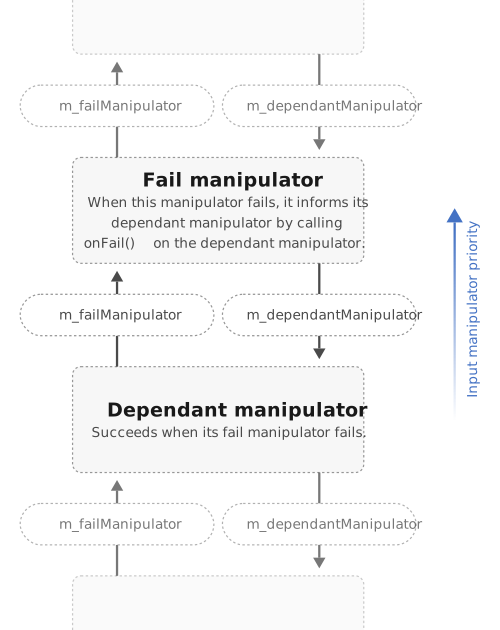
The linking of the manipulators is directional and hierarchical. The linked manipulator is called the dependant manipulator and the manipulator the dependant is linked to is called the fail manipulator. The dependant manipulator has lower priority than the fail manipulator. Lower priority manipulator succeeds only when the higher priority manipulators fail to recognize a gesture. You can link the two manipulators by calling requireToFail() on the dependant manipulator, passing the fail manipulator as argument.
To receive both click and multi-click messages on a node, you need to configure the click manipulator to wait for the failure of the multi-click manipulator:
node->addInputManipulator(clickManipulator);
node->addInputManipulator(doubleClickManipulator);
doubleClickManipulator->setClickCount(2);
tripleClickManipulator->setClickCount(3);
node->addInputManipulator(tripleClickManipulator);
clickManipulator->requireToFail(doubleClickManipulator);
doubleClickManipulator->requireToFail(tripleClickManipulator);
If the dependant manipulator supports delay, when it recognizes a gesture and the fail manipulator has not finished recognizing a gesture, the dependant manipulator sets its own state to StateDelayed. When an input manipulator is in the StateDelayed state, it stops handling events and waits until the fail manipulator finishes recognizing its gesture.
If the fail manipulator fails, Kanzi calls the onFail() of the dependant manipulator. In that case the onFail() method generates the message that was delayed. If the fail manipulator succeeds, Kanzi cancels the dependant manipulator.
To add delay functionality to your own input manipulators, when that input manipulator recognizes a gesture and there is an input manipulator on which your input manipulator depends, your input manipulator must first enter the StateDelayed state. In this case, do not send any messages. When the fail manipulator fails, Kanzi calls the onFail() on your input manipulator. Use this method to send delayed messages. When the fail manipulator succeeds, Kanzi cancels your input manipulator.
You can cancel an input manipulator after it enters one of the following states: -StatePossible -StateBegin -StateChange -StateDelayed.
When you cancel an input manipulator, that input manipulator:
- Stops receiving gesture recognition
- Enters the StateCanceled state
- Calls the onCancel() method
- Enters the StateReady state
Kanzi cancels an input manipulator when:
- You call cancel()
- One of the other input manipulators that are attached to the same node enter one of these states:
- An input manipulator is in one of these states and you call reset():
Gesture recognition
Kanzi dispatches the incoming event data to manipulators attached to nodes in phases:
- Kanzi tunnels the event data to nodes starting from the root node and ending at the hit test node or at the focus node. In this phase only the input manipulators that have the RoutingTunneling routing mode set receive the event data for recognition.
- Kanzi continues to bubble the event data from the hit test or focus node node to the root node, updating the nodes with input manipulators that have the RoutingBubbling routing mode set.
- Kanzi updates the input manipulators that are outside of the hierarchy of the hit test or active focus node.
The touch gesture recognition happens in the notifyTouchInside() or notifyTouchOutside() methods of an input manipulator. Every input manipulator attached to a hit test node receives all the touch points that occurred in the application. In each input manipulator you must set the correct state to inform Kanzi that the input manipulator recognized a gesture. You do this by calling the setState() method with the appropriate State value.
When an input manipulator recognizes a touch event as a starting action of a gesture:
- The input manipulator enters the StatePossible state. Usually every input manipulator takes the first touch point as a possible starting point of the gesture it recognizes. In this phase, every input manipulator in the StatePossible state receives the touch event.
- When the input manipulator recognizes the incoming touch event as a comprehensive gesture, depending on the type of the gesture, this input manipulator sets its state to either StateBegin, StateEnd, or StateFail state.
- Input manipulators which recognize gestures where the touch point location is not changing, such as click or multi-click, and gestures where the touch location is updated, set the state to StateEnd.
- If the gesture recognition fails, input manipulators set the StateFail state value. It is important that you mark the gesture recognition failure in the failing input manipulator. This enables Kanzi to continue dispatching the touch event to the dependant input manipulators. Kanzi calls onFail() method on the dependant input manipulator linked, continuing the gesture recognition in that input manipulator.
During and on gesture recognition, input manipulators can dispatch messages to the attached node, to inform the subscribed message handlers about the progress of the gesture.
- See also
- ClickManipulator, DragAndDropManipulator, LongPressManipulator, MultiClickManipulator, PanManipulator, PinchManipulator



 Public Types inherited from kanzi::PropertyObject