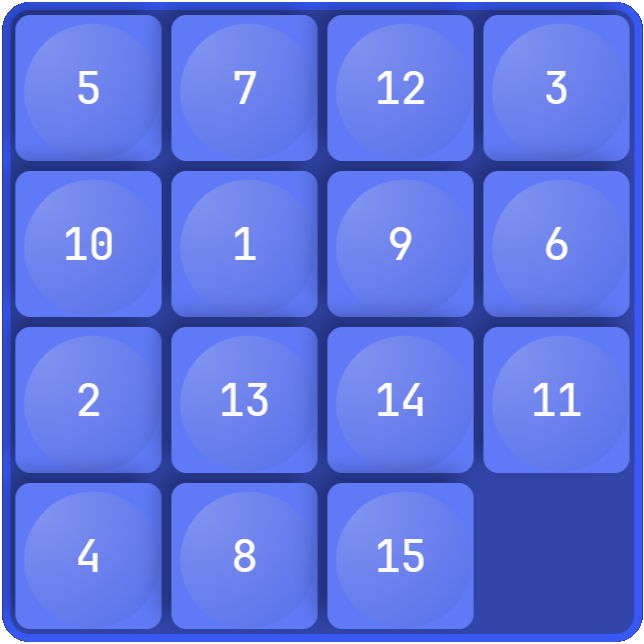
步骤 4 - 随机化网格
在此步骤中,您将学习如何在 Lua 脚本中定义自己的函数。首先定义辅助函数,然后使用这些函数来随机化网格中棋子的初始位置。
要随机化网格:
定义一个返回整数数组的函数。
在 Lua 中,您可以使用
function关键字声明函数。在
grid:removeAllChildren()之前将函数添加到脚本中。备注
此函数从索引 1 开始数组。这在 Lua 中是惯例,但不是必需的。请记住,Kanzi Engine 函数,例如
getChild,从索引 0 开始。-- Declare a function that returns a list of integers from 1 to length. local function createArray(length) -- Initialize a variable that contains an empty array. local array = {} -- Fill the array with integers. for i = 1,length do array[i] = i end return array end
定义一个函数来随机化给定的整数数组,并将其添加到
createArray函数之后。您可以使用内置的 Lua Math 库。
-- Declare a function that randomizes the array argument with Fisher-Yates shuffle.
local function shuffleArray(array)
    -- Loop backward from array length to 2.
    for i = #array, 2, -1 do
        -- Use the Lua Math library to create a random integer.
        local j = math.random(i) -- j is in range [1,i]
        -- Swap the array items at index i and j.
        array[i], array[j] = array[j], array[i]
    end
end
并非所有拼图配置都是可解的15拼图。定义一个函数来检查给定的排列是否表示一个可解的拼图。如果拼图不可解,该函数将修改排列。在
shuffleArray函数之后添加该函数。-- Declare a function that modifies the given permutation to make it a solvable puzzle. local function makeSolvable(permutation) local n = #permutation -- Count the number of inversions in the permutation. local inversions = 0 for i = 1,n do for j = i+1,n do if permutation[i] > permutation[j] then inversions = inversions + 1 end end end -- If the puzzle is not solvable, swap two adjacent pieces to fix it. if inversions % 2 == 1 then permutation[1], permutation[2] = permutation[2], permutation[1] end end
要获得随机化网格,请使用网格创建中的辅助函数。
...

-- Remove all grid items that were created in the project or by the earlier
-- executions of the script.
grid:removeAllChildren()

-- Create a random permutation.
local permutation = createArray(PieceCount)
shuffleArray(permutation)
-- Ensure that the permutation is a solvable puzzle.
makeSolvable(permutation)

...
修改填充网格的脚本部分,以便应用置换。
...

-- Create the grid children.
for i = 1,PieceCount do
    -- Create a grid item.
    local piece = piecePrefab:instantiate("piece_" .. i)

    -- Assign the number to the piece.
    piece:setProperty(PieceIndexProperty, i)

    -- Set the grid coordinates of the new node.
    local p = permutation[i]
    -- Use integer division to get the row index and modulo to get the column index.
    local row = (p-1) // ColumnCount
    local column = (p-1) % ColumnCount

...
当您保存脚本并在 Preview 中点击  时,脚本会以随机顺序填充网格中的15个部分。